

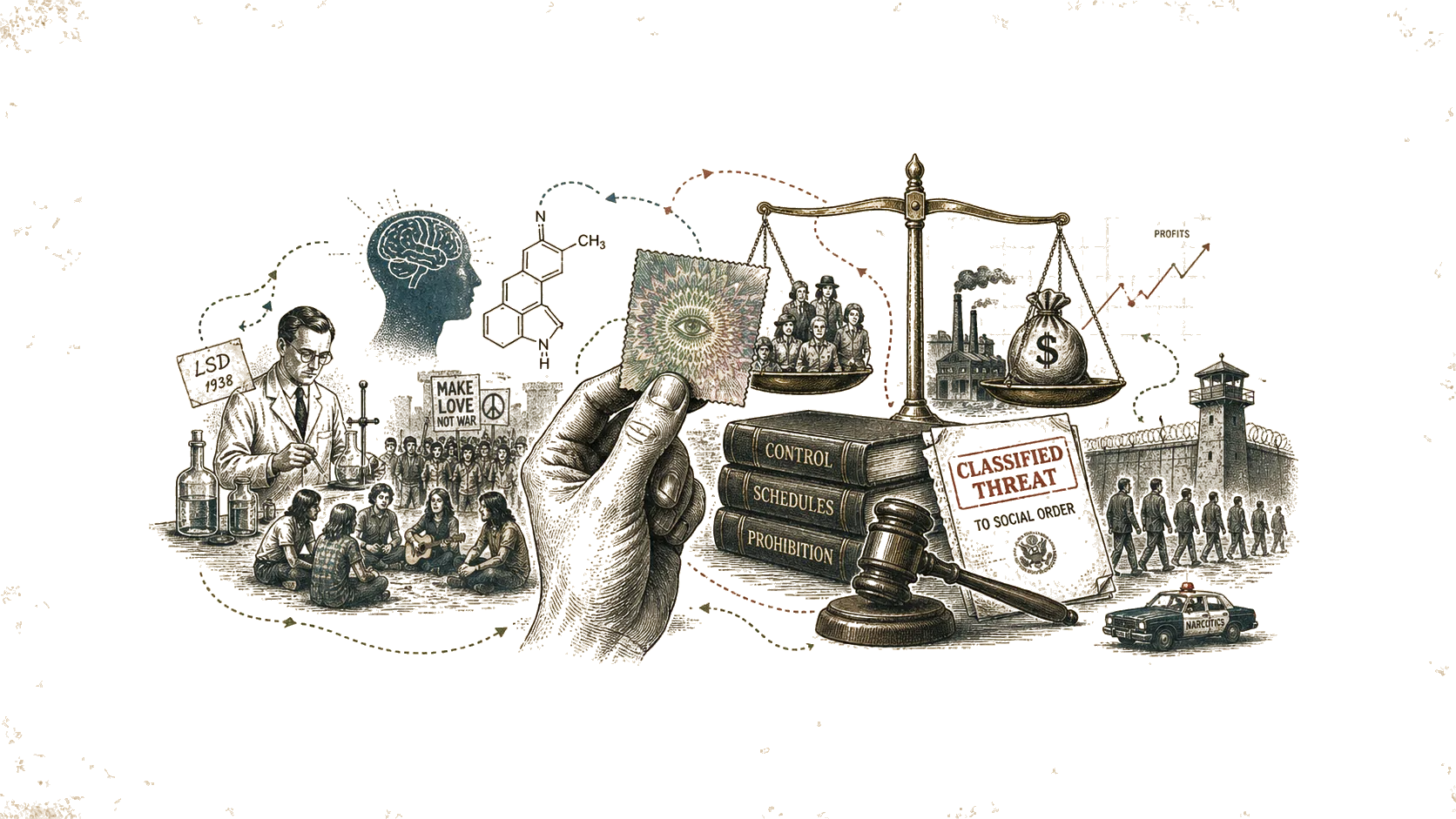
LSD is not physically addictive. At ordinary doses, it is not a drug of mass overdose death. Yet its manufacture can be punished with decades in prison, even life. The official explanation is public safety. The historical record suggests something more disturbing: LSD was outlawed not simply as a poison, but as an unauthorized technology of consciousness.
From Medicine to Menace
By the time the law learned to say "LSD," it had already learned to fear it.
Not in the way it feared heroin, with its ruined veins and visible dependency. Not in the way it feared cocaine, with its violence, money, and compulsive appetite. Not even in the way it privately understood alcohol and tobacco, those legal monuments to profitable harm. LSD frightened the state differently. It did not merely intoxicate. It threatened to change the person who took it - sometimes beautifully, sometimes catastrophically, and always unpredictably.
That difference is still written into the criminal codes of the world. In the United States, lysergic acid diethylamide remains a Schedule I controlled substance, legally grouped with drugs said to have a high potential for abuse, no accepted medical use, and no accepted safety under medical supervision. Federal law allows sentences of ten years to life for trafficking in ten grams or more of a mixture containing LSD. In Britain, LSD is a Class A drug, and production or supply can carry life imprisonment. In Singapore, importing, exporting, or trafficking LSD can bring long imprisonment, life sentences, and caning.
And yet the pharmacological facts sit uneasily beside the penal fury. LSD does not produce physical dependence in the manner of alcohol, opioids, or nicotine. Standard medical references note that hallucinogens do not produce a typical withdrawal syndrome and that physical dependence is not established, while still warning of panic reactions, impaired judgment, persistent perceptual disturbances, and rare long-term psychiatric complications. A major forensic review by David Nichols and Charles Grob describes LSD as physiologically safe and non-toxic at moderate doses, while emphasizing that terrifying experiences, accidents, and rare extreme cases can occur. MSD Manual and Nichols and Grob review
This is the gap that must be explained: a drug with low ordinary-dose lethality and no ordinary physical addiction profile is punished, especially at the manufacturing level, as if it were among the gravest threats a citizen can introduce into society.
The usual explanations collapse under scrutiny. If the point were simply to prevent death, alcohol and tobacco would stand first in line for prohibition. They do not. The Controlled Substances Act explicitly excludes distilled spirits, wine, malt beverages, and tobacco from the definition of a controlled substance. Excessive alcohol use kills about 178,000 people a year in the United States. Cigarette smoking kills more than 480,000 Americans annually. LSD has no comparable mortality burden.
If the point were simply medical usefulness, the history is again more complicated than the law admits. Before LSD became an emblem of disorder, it lived inside legitimate medicine. It was synthesized in 1938 at Sandoz, the Swiss pharmaceutical company, by Albert Hofmann, and its extraordinary psychoactive effects were discovered in 1943. By the 1950s and early 1960s, LSD was not merely a countercultural sacrament. It was a research tool, a psychiatric intervention, and a subject of serious clinical inquiry. A National Academies workshop summary describes a mid-century "golden era" of psychedelic research involving more than 1,000 clinical papers and roughly 40,000 patients treated with psychedelics, especially LSD. National Academies workshop summary
Something happened between the laboratory and the life sentence. The story is not that a dangerous drug was discovered and rationally classified. The story is that LSD escaped every institution that might have tamed it: the pharmaceutical company, the clinic, the university, the military laboratory, the church, the family, the state. Then, once loose, it attached itself to the most volatile symbols of the twentieth century: youth rebellion, antiwar politics, sexual emancipation, ecological consciousness, mystical experience, distrust of authority, and the possibility that the world being sold to citizens was not the only possible world.
The Drug That Did Not Behave Like a Drug
LSD is awkward for drug law because it violates the usual grammar of vice.
Alcohol lowers inhibitions. Nicotine habituates the body into repetition. Heroin and fentanyl hijack survival systems. Cocaine intensifies appetite, status, and compulsion. These drugs can be devastating, but their social roles are legible. They fit familiar categories: pleasure, dependency, relief, escape, stimulation, numbness.
LSD does something stranger. It can produce terror, awe, hilarity, nausea, paranoia, spiritual rapture, ego dissolution, sensual amplification, cosmic identification, or psychological chaos. It is not reliably pleasurable. It is not a simple reward machine. People do not normally take LSD every day; rapid tolerance makes that pattern difficult, and its effects are too demanding for ordinary repetition. The 1966 Senate record itself acknowledged that LSD did not fit the model of physical dependence, noting psychological dependence was not intense and that there was no evidence of physical dependence. 1966 Senate hearing transcript
This should have mattered. Instead, it may have made LSD more frightening.
In a 1966 Senate hearing, Robert Kennedy pressed officials on what sort of drug LSD really was. Was it, he asked, a drug that "deals with the mind"? Dr. Stanley Yolles, then director of the National Institute of Mental Health, answered yes. The hearing framed LSD as a prototype of substances that alter consciousness directly. It was discussed not as a conventional intoxicant, but as a compound capable of rearranging perception and judgment. Medicine on Screen transcript
That language matters. Congress was not merely looking at a poison. It was looking at a mind drug. The distinction explains the disproportion. LSD’s crime, historically speaking, was not only that it might harm the user. It was that it might change the user’s relationship to everything else: work, war, family, God, police, nation, self.
A society can make room for a citizen who drinks too much after work. It has a harder time making room for a citizen who returns from a psychedelic experience convinced that work, war, and the arrangement of modern life are insane.
The Paper Was Sentenced Too
Nowhere is the irrationality of LSD law clearer than in the old federal sentencing rules for blotter paper.
LSD is active in micrograms. A typical dose may contain around one-twentieth of a milligram of the drug. Because the active substance is so tiny, it is commonly distributed on something else: blotter paper, gelatin, sugar, or liquid. For years, federal sentencing counted not merely the LSD but the entire carrier medium. The paper became the drug. The sugar cube became the drug. The law punished the vehicle as if it were the danger.
In Chapman v. United States, decided in 1991, the Supreme Court upheld this logic. The defendants had sold roughly 1,000 doses of LSD on blotter paper. The actual LSD weighed about 50 milligrams. But the blotter paper and LSD together weighed 5.7 grams, enough to trigger a mandatory minimum sentence. The Court held that the blotter was part of the "mixture or substance" containing LSD. Chapman v. United States
The consequences were absurd enough that even the U.S. Sentencing Commission later recoiled. In Amendment 488, the Commission changed the guideline method, instructing courts to treat each dose on a carrier as 0.4 milligrams for guideline purposes rather than using the carrier’s full weight. It explained that carrier weights vary widely and often vastly exceed the weight of LSD itself. Most remarkably, the Commission admitted that the prior system could produce sentences disproportionate to more dangerous drugs, including PCP, heroin, and cocaine. U.S. Sentencing Commission Amendment 488
This was not a psychedelic advocate speaking. It was the federal sentencing authority acknowledging that LSD punishment had become unmoored from pharmacological danger.
But the reform was incomplete. In Neal v. United States, the Supreme Court held that the statutory mandatory minimums still required the carrier-weight method, even after the Sentencing Commission changed the guideline calculation. In other words, the Commission could soften the advisory arithmetic, but it could not undo Congress’s harsher statutory command. Neal v. United States
There is a brutal metaphor here. LSD law punished the medium of transmission. The blotter was not merely evidence. It became the weight of the crime. What mattered was not the amount of toxin, but the number of minds the paper might reach.
One Gram, Thousands of Unauthorized Realities
Manufacturing penalties reveal the state’s deeper fear.
A gram of heroin is a gram of heroin. A gram of cocaine is a gram of cocaine. But a gram of LSD is not intuitively a gram of drug experience. Because LSD is active in micrograms, a small amount can become thousands of doses. That fact converts manufacture into something the state sees as multiplication: one chemist, one batch, one concealed laboratory, and suddenly a vast number of people can undergo experiences that no institution has authorized.
The Drug Enforcement Administration made this logic explicit in its account of the Pickard-Apperson case, which it called the largest LSD laboratory seizure in DEA history. The agency claimed the lab had produced approximately 2.2 pounds of LSD every five weeks, amounting to roughly ten million doses, at a production cost of less than one cent per dose and possible retail prices up to ten dollars per dose. William Leonard Pickard received life without parole; Clyde Apperson received thirty years. DEA release on Pickard-Apperson case
The numbers explain the fury. LSD manufacture is not punished as ordinary drug production. It is punished as the capacity to distribute altered consciousness at industrial scale and microscopic cost. The fear is not only overdose; it is replication. Not only harm; contagion. Not only vice; transmission.
That is why manufacture, in particular, draws the full violence of the law. One dose might be a trip. One lab is a social event waiting to happen.
The Official Story Was Always Public Health. The Archive Says Social Order.
The international history is even more revealing.
The 1971 Convention on Psychotropic Substances placed LSD into the global architecture of prohibition. That treaty, now joined by more than 180 parties, requires severe restrictions on substances in its strictest categories, permitting use only under narrow scientific and medical conditions. UN Treaty Collection
But the archival trail behind that convention does not read like a calm risk assessment. A 2026 study of the negotiations found that the evidence for acute danger and dependency potential was inconsistent or weak, while policy discussions were driven by media panic, youth-counterculture anxiety, Cold War politics, institutional incentives, and the absence of powerful economic defenders for psychedelics. The study argues that psychedelics became a "good enemy": a class of drugs whose symbolic association with deviance made them easy to condemn. 2026 archival study of the 1971 Convention
This phrase - good enemy - may be the key to the whole story.
A good enemy does not have to be the most dangerous enemy. It has to be the most useful one. LSD was perfect. It was foreign enough to seem exotic, scientific enough to seem sinister, youth-coded enough to frighten parents, spiritual enough to alarm secular authorities, anti-institutional enough to disturb governments, and economically undefended enough to sacrifice.
According to the same archival work, early United Nations concern over LSD was triggered partly by press reports. By the mid-1960s, especially in France, newspapers and officials circulated lurid claims tying LSD to psychosis, blindness, leukemia, birth defects, homosexuality, chromosome damage, addiction, brain damage, suicide, and homicide. The point was not that every claim survived scientific scrutiny. The point was that the claims created a climate in which strict control felt obvious before it was proven. SAGE archival study
This is how moral panic becomes law: first the anecdote, then the headline, then the hearing, then the treaty, then the prison sentence.
The Drugs With Sponsors Survived Differently
There was another reason LSD was easy to criminalize: nobody powerful needed it badly enough.
This is not the same as saying there was no money in LSD. There was black-market money, and later there would be biotech and pharmaceutical money in psychedelic-adjacent therapies. But in the decisive years of the 1960s, LSD had lost the one kind of money that matters in regulatory politics: respectable institutional defense.
Alcohol had culture, taxation, tradition, and industry. Tobacco had an enormous commercial lobby. Sedatives, stimulants, and tranquilizers had pharmaceutical companies, doctors, patients, and governments with manufacturing interests. Cocaine, though illegal recreationally, retained enough recognized medical use to be placed in Schedule II rather than Schedule I. DEA drug scheduling
LSD had Sandoz - until it did not.
Sandoz had distributed LSD under the name Delysid and supplied researchers for years. But as publicity worsened and black-market use grew, the company retreated. The withdrawal did not merely deprive researchers of a product. It deprived LSD of a patron. Historian Matthew Oram has shown that, after Sandoz withdrew from sponsorship in the mid-1960s, federal agencies such as the FDA and NIMH tried in some ways to preserve legitimate research access. But the field had become politically contaminated, institutionally fragile, and scientifically difficult to standardize under the stricter post-thalidomide drug-development regime. Matthew Oram on FDA regulation and LSD research
The distinction is important. LSD research was not simply murdered overnight by police. It slowly lost the institutional contest. The evidence base was promising but messy. The therapy model was strange: often one or a few profound sessions rather than daily dosing. Trials were hard to blind. Outcomes were hard to measure. Charismatic therapists sometimes outran the data. Advocates made claims that formal medicine was not prepared to certify. At precisely that moment, the drug’s public image became fused with Timothy Leary, campus unrest, antiwar protest, and the counterculture. National Academies workshop summary
The law then converted that institutional collapse into a scientific-sounding verdict: no accepted medical use.
But "accepted" is not a neutral word. Accepted by whom? Under what rules? With what sponsor? In what political climate? A drug does not become accepted by possessing abstract promise. It becomes accepted through institutions. LSD lost those institutions before they could domesticate it.
How a Research Chemical Became a Rebellion Chemical
To understand why LSD became so threatening, one has to look not only at the drug, but at the moment into which it arrived.
Postwar Western society was built on hierarchy and discipline: the military chain of command, the nuclear family, the corporation, the factory, the suburb, the university, the church, the psychiatric hospital, the television set. LSD entered that world as a solvent. It did not create the rebellions of the 1960s. Civil rights, feminism, anti-colonialism, antiwar politics, gay liberation, environmentalism, and student revolt all had deeper causes. But LSD moved through many of those spaces as a chemical metaphor for rupture.
It offered, or seemed to offer, direct experience against received authority. Why trust the priest if one has seen God in a bedroom? Why trust the general if one has felt universal kinship? Why trust the advertiser if the bright surface of consumer life suddenly appears grotesque? Why trust the psychiatrist if madness and revelation seem separated by setting, support, and interpretation?
These are not necessarily rational conclusions. LSD can produce delusion as easily as insight. It can inflate the ego while claiming to dissolve it. It can make nonsense feel profound. But governments did not need every psychedelic revelation to be true. They only needed enough citizens to come back from the experience less governable than before.
The archival record supports this social-order reading. International debates increasingly framed psychedelics as threats tied to youth, students, hippies, alienation, and social disruption. The 2026 archival study concludes that strict controls emerged not from systematic pharmacological risk assessment alone, but from symbolic politics and anxiety over deviance. archival study of psychedelic scheduling
That is why LSD’s non-addictiveness did not protect it. Heroin frightens the state because it can enslave the citizen. LSD frightened the state because it might make the citizen strange.
The Government’s Private Fascination
Before LSD became a public menace, it was a government instrument.
During the Cold War, the CIA and U.S. military studied LSD as part of a broader obsession with interrogation, influence, psychological vulnerability, and what officials imagined as "brain warfare." MKULTRA and related programs involved surreptitious dosing, unethical experiments, and attempts to understand whether LSD could be used to manipulate or destabilize people. Senate records later documented nonconsensual administration of LSD and the now-infamous death of Frank Olson, an Army scientist who had been secretly dosed with LSD and died days later after falling from a New York hotel window. Senate MKULTRA hearing record
This history does not prove that the CIA banned LSD to keep it for itself. That would be too neat, and the available evidence does not support it. The importance of MKULTRA is subtler. It shows that the state’s earliest high-level interest in LSD was not ordinary public health. Officials saw the compound as a technology of influence, disorientation, confession, control, and psychological exposure.
When the same kind of compound escaped into public culture, the official imagination was already primed. LSD was not simply another intoxicant. It was a substance that might open the mind, break the mind, reveal the mind, or be used against the mind.
The public was told a safety story. The classified record shows a power story.
Medical Promise, Buried and Returning
There was always another possible path.
In the 1950s and early 1960s, psychiatrists investigated LSD for alcoholism, anxiety, depression, trauma, addiction, and end-of-life distress. Some studies were weak by modern standards. Some claims were inflated. But it is false to say LSD had no medical rationale. Modern reviews have found signals of benefit, including a 2012 meta-analysis of randomized trials suggesting a beneficial effect of a single LSD dose in alcoholism treatment. Frontiers review of LSD therapy
The field is now returning under stricter rules. The FDA has issued guidance for clinical investigations of psychedelic drugs, addressing trial design, safety monitoring, abuse potential, and psychotherapy-related complexities. Companies are developing regulated psychedelic therapies, including LSD-derived or LSD-based compounds. In 2024, MindMed announced that its LSD-based candidate MM120 had received FDA breakthrough therapy designation for generalized anxiety disorder, although that designation is not approval and does not alter LSD’s Schedule I status. FDA psychedelic-drug guidance
This revival exposes the old contradiction. The same category of substances once declared medically unacceptable is now being reconsidered by the medical establishment for some of the very conditions early researchers studied. The difference is not that the molecule has changed. The institutions around it have.
Here lies one of the most revealing truths about drug law: "no accepted medical use" can be less a statement about nature than a statement about power. A therapy becomes accepted when acceptable institutions accept it. Until then, its promise is legally invisible.
The Innovators and the Myth Problem
Any honest article about LSD must resist two forms of propaganda.
The first is the old prohibitionist myth: LSD turns ordinary citizens into maniacs, suicides, degenerates, or permanent psychotics with such frequency that only the harshest punishment can protect society. The evidence does not support that level of panic.
The second is the psychedelic romance: LSD users, in some vast majority, became enlightened revolutionaries who improved the world. That is also unsupportable. LSD has been taken by fools, narcissists, seekers, artists, engineers, mystics, criminals, saints, patients, teenagers, and wrecks. It does not confer virtue. It amplifies, destabilizes, discloses, confuses, and sometimes clarifies. The result depends on the person, the setting, the dose, the support, the interpretation, and luck.
But the cultural record does show that LSD circulated through networks that later transformed parts of modern life.
Steve Jobs famously described taking LSD as among the most important experiences of his life. That anecdote does not mean LSD built Apple. It means one of the central figures of consumer technology believed psychedelic experience changed his imagination. Association for Psychological Science discussion
Stewart Brand offers an even richer case. Brand moved through the Merry Prankster and Whole Earth worlds, where psychedelics, systems thinking, ecological consciousness, and early computing culture overlapped. Fred Turner’s history of the Whole Earth network shows how countercultural ideals helped shape visions of computers as tools of personal empowerment rather than merely instruments of bureaucracy, war, and corporate control. Fred Turner on the Whole Earth network
Kary Mullis, the Nobel Prize-winning biochemist associated with PCR, also became part of psychedelic lore because of his public comments about LSD. Here caution is essential. PCR was not a simple product of an acid trip, and scientific discovery is not reducible to one man’s altered state. But the persistence of the story reveals something real: LSD became associated with unconventional cognition, boundary-crossing, and rebellion against established mental forms. Berkeley profile of Kary Mullis
There is also emerging research suggesting that classic psychedelic use is associated with nature-relatedness and ecological behavior, though causation remains uncertain. Such findings should not be inflated into moral proof. They do, however, help explain why LSD became culturally linked to ecological consciousness and anti-consumerist identity. study on psychedelics and nature relatedness
So the careful formulation is this: LSD did not create the personal computer, environmentalism, molecular biology, or antiwar politics. But it moved through the lives and communities of people who were reimagining what humans, machines, nature, and institutions were for. That made it culturally fertile. It also made it politically dangerous.
Why Alcohol Survives and Acid Does Not
The comparison with alcohol is unavoidable because it exposes the moral architecture of prohibition.
Alcohol is not merely tolerated despite its harms. It is woven into state revenue, hospitality, sport, celebration, diplomacy, advertising, masculinity, femininity, class performance, and ordinary social permission. It can destroy families and bodies while leaving the structure of society intact. In many settings, it reinforces the world as it is: the after-work drink, the corporate reception, the patriotic toast, the sports sponsorship, the wedding, the bar where alienation is rented back to the alienated by the glass.
Tobacco is similar in a different register. It kills slowly, profitably, predictably. The smoker remains recognizable as consumer, worker, taxpayer, patient. Nicotine dependence is disastrous for health but legible to commerce.
LSD is not so cooperative. It is difficult to monetize as a daily habit. It does not reliably create a returning customer in the way nicotine does. Its therapeutic promise, when taken seriously, often involves one or a few high-intensity sessions with trained support, not lifelong consumption. Its nonmedical use can produce not steady demand but rupture: a person may take it once and change, or take it once and never want it again.
This makes LSD commercially awkward and politically unruly. It can be sold, of course, and black markets have sold it profitably. But it is not naturally aligned with the dominant profit machine of addiction, maintenance, and repeat consumption. Nor is it easily domesticated into ordinary intoxication culture.
That does not make LSD morally superior. It makes it structurally different.
And in drug law, structural difference can be punished as deviance.
The Cocaine Objection
Cocaine complicates the story, but does not overturn it.
If LSD is illegal partly because it lacked a powerful lobby and official medical use, why is cocaine illegal too? The answer is that cocaine occupies a different legal category. Recreational cocaine is prohibited, but cocaine itself remains Schedule II in the United States because it has recognized medical use under severe restrictions. LSD is Schedule I. The distinction is not that cocaine is safer. It is that cocaine retained enough institutional medical legitimacy to avoid the legal category reserved for substances said to have no accepted medical use. DEA scheduling
This reveals the law’s true structure. It is not a pure danger scale. It is a legitimacy scale. A dangerous substance with a sanctioned medical role can remain inside the system. A less lethal substance associated with social rupture can be cast outside it.
That is why the question "Why not cocaine?" leads back to the deeper answer. The state does not merely ask what a drug does to the body. It asks whether the drug can be institutionally owned.
The Self-Fulfilling Schedule
Schedule I created a loop that has lasted more than half a century.
First, LSD’s medical research became politically and institutionally fragile. Then it was classified as having no accepted medical use. That classification made research harder, more expensive, more bureaucratic, and less attractive to sponsors. The resulting lack of modern clinical evidence then reinforced the original classification.
The law called this science. In practice, it was also circularity.
Researchers could still study LSD under controlled conditions, but the barriers mattered. A stigmatized, Schedule I substance requires special approvals, secure handling, regulatory compliance, and institutional courage. Young scientists avoid career risk. Universities avoid reputational risk. Sponsors avoid financial risk. Ethics boards become cautious. The drug remains under-researched, and under-research is then mistaken for lack of value.
This is how prohibition protects itself from falsification.
When the modern psychedelic renaissance began, it did so not because the old classification had been vindicated, but because researchers, philanthropists, companies, and regulators slowly rebuilt the institutional scaffolding that LSD had lost. The compound did not suddenly become interesting. It became institutionally thinkable again.
The Real Crime Was Escape
By the late 1960s, LSD had become the perfect enemy for a state learning to govern consciousness through medicine, media, policing, schools, and war.
It was potent enough to be sensationalized. Cheap enough to spread. Strange enough to demonize. Associated with youth enough to terrify parents. Linked to antiwar politics enough to alarm governments. Lacking a powerful industry sponsor enough to be sacrificed. Difficult to study enough to be dismissed. Difficult to standardize enough to be excluded. Difficult to tax enough to be criminalized. Difficult to explain enough to become myth.
Public-health language supplied the official justification. But the punishment gap tells another story.
If LSD were punished according to direct lethality, it would not be treated more severely than drugs that kill hundreds of thousands. If it were punished according to physical addiction, it would not sit in the strictest category. If it were punished according to medical promise, its early research history would matter more. If sentencing were calibrated to toxicological quantity, blotter paper would never have counted as drug weight.
What LSD law punishes most severely is not the trip already taken. It punishes the capacity to spread trips. It punishes the chemist, the distributor, the carrier, the network. It punishes the possibility that consciousness might be altered outside permission.
That is the hidden logic connecting the Senate hearings, the UN panic, the carrier-weight scandal, the Sandoz retreat, the counterculture, MKULTRA, and the modern Schedule I trap. LSD became illegal because it escaped the institutions that might have made it respectable, and once it escaped, it attached itself to a question modern states are built to suppress: What if the reality being enforced is not the only one?
The Acid Exception
There is no need to romanticize LSD to see the injustice. It can harm. It can terrify. It can destabilize vulnerable people. It can contribute to accidents, delusions, and psychiatric crises. It should not be treated casually, and no serious account should pretend otherwise.
But criminal law is not supposed to be a mythology machine. It is supposed to justify its violence. On LSD, the justification remains thin.
The official story says LSD is prohibited because it is too dangerous. The record says it was also prohibited because it became too symbolic. It symbolized youth disobedience, antiwar consciousness, mystical autonomy, psychiatric unruliness, ecological identification, and the refusal of ordinary consumer life. It symbolized, fairly or not, the citizen who might not return to work the same person.
That is why the law grew teeth around a molecule measured in micrograms.
LSD was not banned only as a substance. It was banned as a possibility: that people might encounter themselves, one another, nature, authority, and reality without the usual filters - and that some of them might decide the filters were the prison.
The harshness of LSD law is therefore not an accident. It is a confession. The state can tolerate intoxication. It can tolerate addiction when addiction is profitable, familiar, or socially managed. What it has never tolerated well is transformation it does not control.



 We respect your privacy.