

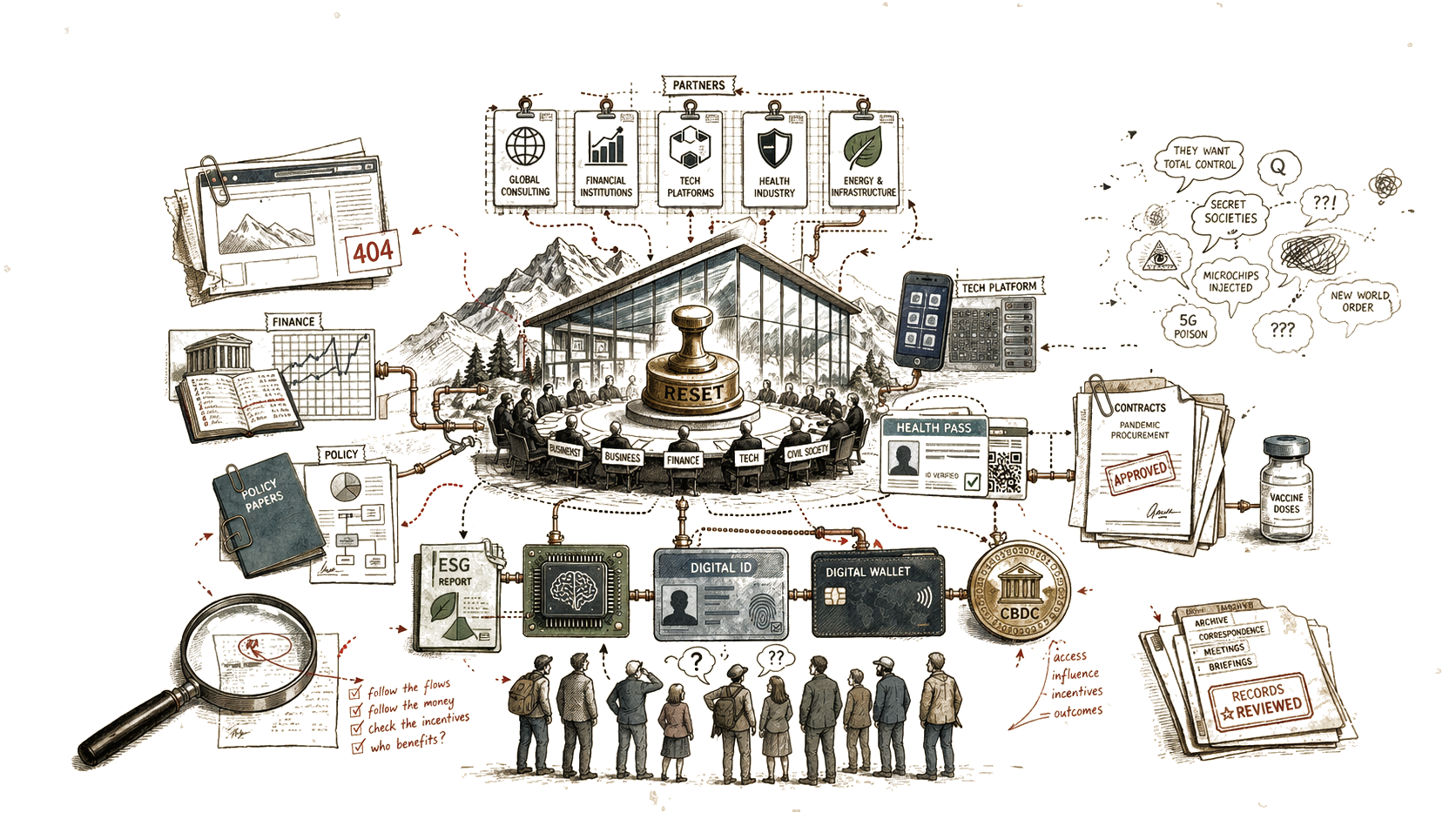
How Davos turned a crisis-era business agenda into the perfect conspiracy machine - and why the real scandal is not a secret plan, but a public influence system dressed up as salvation.
I. The Sentence That Lit the Match
The Great Reset did not begin in a basement. It did not arrive as a leaked cable, a captured phone call, or a banking record slid under a reporter's door. It began in public, under the logo of the World Economic Forum, at the precise moment when much of the world was frightened, locked down, unemployed, medically uncertain and politically disoriented.
On June 3, 2020, Klaus Schwab, founder of the World Economic Forum, published an article arguing that COVID-19 had shown that a reset of economic and social foundations was possible. He described the pandemic moment as a chance to advance stakeholder capitalism and wrote that every country and every industry would need to be transformed. The article remains online, under the headline "Now is the time for a ‘great reset'".
That is the first hard fact. The phrase was not invented by fringe broadcasters, message boards or opposition politicians. The WEF chose it. The WEF promoted it. The WEF attached it to COVID-19, stakeholder capitalism, the Fourth Industrial Revolution and a new social contract.
The same day, the Forum issued a press release announcing that "The Great Reset" would be the theme of a 2021 summit. It framed the initiative as a commitment to build the foundations of a more fair, sustainable and resilient future. It cited the Prince of Wales, the United Nations secretary-general, the IMF managing director, Mastercard, Microsoft, BP and other figures from what the WEF calls stakeholder society.
The language was moral. The machinery was corporate. The timing was combustible.
For citizens, the spring of 2020 was not an abstract "opportunity." It was a period of emergency powers, school closures, police restrictions, collapsing small businesses, hospital fear, platform censorship fights and unprecedented public-health coercion. Into that atmosphere came an elite institution announcing that the crisis had made a "reset" possible.
It is difficult to imagine a more efficient way to manufacture suspicion.
II. The Forum's Product Was Not Secrecy. It Was Access.
The WEF's defenders often argue that it cannot be a secret world government because it has no army, no legislature, no tax authority and no binding legal power. That is true, as far as it goes. But it misses the more important point. Influence does not require a throne. It requires proximity, repetition, vocabulary, legitimacy, capital and rooms where policy language is softened before it becomes policy.
The World Economic Forum describes its partners as "leading global companies" and says they are the "driving force" behind the Forum's programmes. Its partner page says those companies engage in centres "to shape the future" and access networks and experts for strategic decision-making. A separate WEF description of partnership categories says strategic partners may participate in decision-making, steering boards and advisory groups, and that senior executives are personally involved in shaping Forum initiatives.
This is not a hidden admission. It is marketing copy.
The current WEF strategic-partner page says the community includes companies that work with the Forum to help shape industry, regional and global agendas. The list includes Amazon, Aramco, AstraZeneca, Bank of America, BlackRock, Google, Gulfstream Aerospace, Mastercard, Meta, Microsoft, Mitsubishi Heavy Industries, Morgan Stanley, Palantir, PayPal, Pfizer, Salesforce, Sanofi, Swiss Re, UBS, Visa and others. That list alone explains why the public reaction hardened. Banks, oil companies, pharmaceutical companies, technology platforms, consultancies, payment networks, insurers, aerospace firms and asset managers were not watching the reset from outside the glass. They were inside the architecture.
The money trail at the top layer is also public. The WEF's 2024–2025 annual reporting says partnership and membership revenue stood at CHF 287 million. The same report said the partnership base had risen to a record high of 925, with more than 1,500 business leaders participating in the Annual Meeting.
That does not prove a secret conspiracy. It proves something more durable: the WEF is an access economy. It sells participation in the conversation about the future.
And when the conversation is about the future of health, money, identity, climate, labor, artificial intelligence, trade and war, access is not a side issue. It is the issue.
III. Why Would Davos Shoot Itself in the Foot?
The question looks damning only if we assume the WEF was speaking to the public. It was not. Or at least, not primarily.
"Great Reset" sounds menacing to a shop owner under lockdown. It sounds like mandate language to a boardroom. It says: history is moving, systems are being redesigned, and if your company is not in the room, someone else will write the rules.
That is the most plausible explanation for the branding disaster. The phrase was not designed for ordinary citizens. It was designed for elites who think in terms of transitions, shocks, scenarios, governance gaps and policy windows. To that audience, "reset" meant urgency. To the public, it sounded like override.
Schwab's own record supports this. In 2025, he wrote that stakeholder capitalism had been the foundation of his decision to establish the WEF in 1971. In that article, he described stakeholder capitalism as a model in which companies consider employees, customers, suppliers, communities and the environment rather than shareholders alone. He also acknowledged criticism that the concept can be used as a marketing tool and that ESG metrics can lack clarity. The piece is here: "What stakeholder capitalism is and what it isn't."
This matters. The Great Reset was not a new doctrine invented during COVID-19. It was a legacy doctrine given emergency lighting.
That explains the WEF's apparent self-harm. It was not thinking like a democratic political campaign. It was thinking like an institutional convenor. It believed it could put banks, technology companies, pharmaceutical firms, oil interests, asset managers, governments, NGOs and international organizations into one vocabulary of "stakeholders," then sell the arrangement as a moral upgrade over shareholder capitalism.
But the public saw the cast list. The public saw the crisis. The public saw the slogan. And the public drew its own conclusions.
The WEF did not speak in code. It spoke in boardroom poetry, and forgot the rest of the world could hear.
IV. The Page That Disappeared, But Not Quite
The original Great Reset record has not been erased. The launch article remains. The press release remains. The book page remains. The WEF's 2020 article still contains a line telling readers to visit the Great Reset microsite. But the direct URL, weforum.org/great-reset, now returns a 404 error.
This is one of the cleaner findings in the file: the Great Reset was not memory-holed. It was orphaned.
The WEF's June 2020 article also now carries a warning asking readers to help prevent disinformation, saying the article has been intentionally misrepresented on other websites. That warning is important. It shows the Forum knows the phrase became toxic.
The safest explanation is mundane and political at the same time. Corporate websites retire microsites constantly. But organizations also retire language that has become reputationally expensive. "The Great Reset" became reputationally expensive. The WEF did not delete every trace. It simply stopped centering the brand.
Speculation, clearly marked: the darker possibility is that internal communications show the Forum knew the phrase was damaging, knew critics were using accurate WEF language against it, and chose to de-hub the page as reputational triage. That is plausible. It is not proven by the public record. Proving it would require internal communications, web-governance records, CMS logs, crisis-communications memos and board discussions about the phrase.
What can be said now is enough: the slogan was once central enough to launch a global initiative. It is now inconvenient enough that the central page is gone.
V. What Was Actually Implemented?
The Great Reset was never a single law. It was never a treaty. It was never one signed operational order. Treating it as a secret master plan weakens the story. The stronger story is that pieces of the Great Reset agenda were absorbed into ordinary policy, procurement, regulation and infrastructure - while other pieces stalled, were resisted, or were rebranded.
The first implemented piece is the WEF model itself: public-private governance. That did not begin with COVID-19, and it did not end with the Great Reset. It is the Forum's business model. In 2026, the WEF's Annual Meeting in Davos convened nearly 3,000 leaders from 130 countries, including hundreds of top political leaders, dozens of heads of state and government, and roughly 830 CEOs and chairs, under the theme "A Spirit of Dialogue."
The phrase had changed. The architecture had not.
The second implemented piece was sustainability reporting and stakeholder-capitalism infrastructure. In Europe, the Corporate Sustainability Reporting Directive began applying to the first companies for the 2024 financial year, with reports published in 2025. The European Commission describes the regime as requiring large and listed companies to report on social and environmental risks and impacts. But the same policy stream has since faced rollback and simplification. The Commission's own page notes a 2025 simplification package and proposals to limit obligations to the largest companies. The official file is here: Corporate sustainability reporting.
In the United States, the counterattack was sharper. In March 2025, the Securities and Exchange Commission voted to end its defense of climate disclosure rules, calling them costly and intrusive. The SEC's own release is here: SEC Votes to End Defense of Climate Disclosure Rules.
So the sustainability module was not simply implemented. It was implemented, fought, narrowed and politicized.
The third implemented piece was digital health certification. The EU Digital COVID Certificate was real, large-scale and temporary. The European Commission says more than 2.3 billion certificates were issued, that the regulation entered into application in July 2021, and that it expired on June 30, 2023. On July 1, 2023, the World Health Organization took up the EU system as the basis for a global digital health certification network. The Commission's record is here: EU Digital COVID Certificate.
The WHO now describes the Global Digital Health Certification Network as infrastructure built on the experience of COVID certificate systems, designed to support additional use cases such as vaccination documentation, prescriptions and patient summaries. The WHO page is here: Global Digital Health Certification Network.
This is where careful language matters. It is false to say the WEF secretly installed a global digital ID system through COVID certificates. It is also false to pretend no infrastructure survived. The bridge is real. The intent behind the bridge remains the question.
Separately, Europe is moving toward permanent digital identity wallets. The European Commission says member states will make digital identity wallets available to every citizen, resident and business by the end of 2026. That project is documented here: European Digital Identity.
The fourth implemented piece was AI and digital governance. Schwab's 2016 essay on the Fourth Industrial Revolution described a technological transformation that would blur physical, digital and biological spheres and require an integrated response involving public and private sectors, academia and civil society. That framing predates COVID-19 and is available here: The Fourth Industrial Revolution.
By 2024, AI governance had moved from white-paper language into law. The EU AI Act entered into force on August 1, 2024, with broad application scheduled for August 2, 2026, subject to staged exceptions. The official EU page is here: AI Act.
The fifth implemented piece - though unevenly - was central bank digital currency exploration. The Atlantic Council's CBDC tracker says 137 countries and currency unions, representing 98 percent of global GDP, are exploring central bank digital currencies, with dozens in advanced phases or pilot projects. The tracker is here: Central Bank Digital Currency Tracker.
Europe continues to prepare. The European Central Bank says it aims to be ready for a possible first issuance of a digital euro during 2029, assuming EU legislation is adopted in 2026. The ECB file is here: Digital euro.
But the same lane also shows why a simple "the plan is working" narrative fails. In January 2025, the White House issued an executive order prohibiting federal agencies from establishing, issuing or promoting a CBDC. The order is here: Strengthening American Leadership in Digital Financial Technology.
Programmable money is not a fantasy. A unified global programmable-money conspiracy remains unproven.
VI. The Money Did Not Need a Conspiracy Theory. It Had Purchase Orders.
The most concrete money trail is not hidden in Davos. It is buried in pandemic procurement.
In Europe, vaccine contracts were massive and politically sensitive. The European Commission's vaccine strategy records major advance purchase agreements, including Moderna contracts totaling hundreds of millions of doses. The official page is here: EU Vaccines Strategy.
The transparency fight is not theoretical. In Switzerland, the Federal Administrative Court ruled in February 2026 that COVID-19 vaccine contracts with Moderna and Novavax must be disclosed under freedom-of-information law. The court's release is here: Covid-19 vaccine contracts must be disclosed. The Swiss health authority's procurement page records the follow-up disclosure process here: Procurement contracts for COVID-19 vaccines.
The EU faced its own transparency scandal. Reuters reported that the EU General Court criticized the European Commission over limited access to COVID-19 vaccine purchase agreements, and a later Reuters report covered the court's annulment of the Commission's refusal to disclose text messages allegedly exchanged between Commission President Ursula von der Leyen and Pfizer CEO Albert Bourla. Those records are here: EU court criticises Commission over handling of COVID vaccine contracts and here: Court annuls rejection in vaccine messages case.
This is where the story gets cleaner. It is not necessary to prove that COVID-19 was engineered. It is not necessary to prove that Davos directed procurement. The public record already shows emergency purchasing, opacity, pharmaceutical leverage, judicial fights and enormous transfers of public money.
The money did not require a conspiracy theory. It had contracts.
VII. What Did Not Happen - Or At Least Has Not Been Proved
A serious investigation has to kill weak claims as aggressively as it follows strong ones.
There is no hard public evidence that the WEF planned COVID-19. There is no hard public evidence that the Great Reset was a binding operational order. There is no hard public evidence that a single command structure directed ESG, vaccine procurement, digital identity, CBDCs and AI law from Davos. There is no hard public evidence that the viral "you will own nothing" line was a formal WEF policy to abolish private property.
That last point matters because bad claims are useful to powerful people. The more absurd the claim, the easier it becomes to dismiss the entire subject. Microchips, lizard monarchies, universal property abolition and comic-book world government are not just wrong; they are strategically destructive. They turn valid scrutiny into a circus.
But the absence of a master plot does not absolve the WEF. The record shows something real: a crisis-era attempt to accelerate public-private governance, stakeholder capitalism, digital infrastructure, sustainability metrics and business transformation. It shows a corporate partner system in which the world's largest companies gain structured proximity to agenda-setting. It shows pandemic procurement that deserved more transparency than it received. It shows digital health systems that expired in one legal form and survived in another technical form. It shows CBDC projects advancing in some jurisdictions and being blocked in others. It shows the slogan disappearing from the center of the website after it became politically toxic.
The conspiracy was not necessary. The system was sufficient.
VIII. The Information Trap
The Great Reset became the perfect conspiracy machine because enough of it was real.
The WEF really did use the phrase. It really did attach the phrase to COVID-19. It really did talk about stakeholder capitalism and transformation. It really does have corporate partners. Those partners really do include banks, asset managers, pharmaceutical firms, technology platforms, payment companies and energy interests. The WEF really does describe partners as shaping agendas. Digital health certificates really were implemented. WHO really did inherit the EU certificate framework for a global digital health network. CBDCs really are being explored across most of the global economy. AI governance really is becoming law. Vaccine contracts really were opaque enough to end up in court.
Then came the overreach. Claims ran ahead of evidence. In the public imagination, "public-private cooperation" became world government, digital certificates became permanent social credit, CBDC pilots became instant programmable tyranny, sustainability reporting became immediate property abolition, and every participant on a WEF list became a co-conspirator.
That leap helped the institutions under scrutiny.
Speculation, clearly marked: it is plausible that, once the wildest conspiracy narratives took hold, the WEF and its defenders benefited from the confusion. They could point to the craziest versions of the story and use them to discredit harder, better questions about access, procurement, partner influence, digital infrastructure and regulatory capture. There is no public proof that the WEF intentionally cultivated that effect. But the effect itself is visible.
The conspiracy theories did not need to be invented by Davos to become useful to Davos.
IX. The Current Moment: Continuation and Backlash
By 2026, the WEF's posture had changed. The Great Reset brand was gone from the center stage. Davos 2026 was convened under "A Spirit of Dialogue," a phrase so cautious it reads like crisis communications. The meeting still brought together nearly 3,000 leaders. It still featured governments, CEOs, civil society and international organizations. But the revolutionary vocabulary had softened.
The leadership picture also changed. The WEF's current leadership page says the Forum is chaired by co-chairs Larry Fink and André Hoffmann, with Alois Zwinggi serving as interim president and CEO. Fink is chairman and CEO of BlackRock; Hoffmann is vice chairman of Roche Holding. The WEF leadership page is here: Our leadership and governance.
In February 2026, the WEF announced that Børge Brende had stepped down and that Zwinggi would serve as interim president and CEO. The Forum said an independent review had found no additional concerns beyond previously disclosed issues. The statement is here: Press Statement from Co-Chairs André Hoffmann and Larry Fink.
This is not proof of the Great Reset theory. It is proof that governance and trust are not side issues for the WEF. They are existential issues. The institution sells legitimacy. When legitimacy becomes suspect, the business model trembles.
Current events are therefore not simply "part of the plan." Some are continuations of the Davos model: digital identity, AI governance, sustainability reporting, health certification networks, CBDC research, public-private climate and development partnerships. Others are the opposite: anti-ESG politics, CBDC bans, sustainability-rule rollbacks, nationalist industrial policy, distrust of global institutions, and the political collapse of elite consensus.
The Great Reset did not become a finished world plan. It became a contested operating system.
X. Davos as the Back Room in Public
Davos has always had a theatrical contradiction. It is public enough to livestream, credential, photograph and brand. It is private enough to matter.
Switzerland's own government describes the WEF Annual Meeting as requiring extraordinary security coordination. For 2026, Swiss authorities estimated additional security costs of about CHF 9 million, with the WEF paying half and public authorities sharing the rest. The Swiss government page is here: World Economic Forum Annual Meeting 2026.
That does not make Davos sinister. It makes Davos powerful. Power has logistics. Power has badges. Power has motorcades. Power has private dinners after public panels. Power has corporate houses, hotel suites, security perimeters, side meetings and follow-up calls that never appear in the program.
The WEF does not need to be a secret government to be a pressure point. It is something more plausible and less cinematic: a prestige machine for elite coordination. It offers neutral language to unequal actors. It gives corporate power a civic costume. It turns policy conflict into "dialogue." It turns lobbying-adjacent proximity into "stakeholder engagement." It turns participation into virtue.
That is why the partner language matters. When the WEF says its partners help shape the future, the correct journalistic response is not hysteria. It is: show us the contracts, the agenda-setting process, the redlines, the steering groups, the private calendars, the procurement links, the emails, the beneficial interests and the follow-up meetings.
The unanswered questions are not cosmic. They are documentary.
XI. What the Records Prove
Hard facts: The WEF publicly launched the Great Reset in 2020, tied it to COVID-19, stakeholder capitalism, economic transformation and the Fourth Industrial Revolution, and promoted it with global institutional partners. The WEF publicly describes corporate partners as central to Forum programmes. Its strategic-partner list includes major firms in finance, technology, energy, pharmaceuticals, payments, insurance, logistics and consulting. The WEF earns substantial partnership and membership revenue. The central Great Reset URL now returns a 404 while related pages remain online.
Strong inference: The Great Reset functioned less as a secret plan than as a crisis accelerator for pre-existing elite agendas: stakeholder capitalism, ESG metrics, digital transformation, health certification, AI governance, public-private partnership and resilience policy. COVID-19 created the opening. Davos supplied the vocabulary.
Weak or unproven claims: There is no public proof that the WEF engineered the pandemic, directed national vaccine contracts, controlled platform moderation, imposed a global digital identity system, or ordered a centralized CBDC regime. The partner list is evidence of access and influence, not proof of criminal conspiracy by every company named on it.
The central finding: the WEF did not need a secret conspiracy to create conspiracy belief. It made elite coordination visible enough to alarm the public, but vague enough to deny operational responsibility.
XII. The Real Scandal
The Great Reset was badly named, but the name was not the whole problem. The problem was the collision of three forces: crisis, corporate power and managerial language.
At the very moment ordinary people were being told to accept extraordinary restrictions, an elite institution announced that the crisis proved systems could be reset. At the very moment small businesses were dying, the partner class gathered around transformation. At the very moment citizens were losing trust in public-health authorities, governments were entering opaque contracts with pharmaceutical companies. At the very moment platforms were moderating pandemic discourse, the WEF warned about misinformation. At the very moment people feared permanent emergency infrastructure, digital health certificates were built, expired, and then fed into a broader global health certification network.
None of that proves the cartoon version of the conspiracy. It proves why the cartoon version spread.
The WEF says it wants to improve the state of the world. The more uncomfortable possibility is that, in elite hands, improving the state of the world has come to mean managing it - through boards, metrics, dashboards, partnerships, platforms, certificates, standards, rankings, pilots, scenarios and closed-room consensus among people who will never have to live under the policies in the same way as everyone else.
That is not a secret plan. It is a governing style.
And it is precisely the kind of governing style that breeds conspiracy thinking, because it keeps insisting that the public trust a process the public can see just enough to distrust.
XIII. Final Ledger
The Great Reset was not fake. It was not omnipotent. It was not a single implemented world order. It was a branded crisis agenda from an institution whose business is elite convening. Parts of that agenda advanced. Parts were blocked. Parts were absorbed into ordinary policy. Parts were abandoned, softened or renamed after the backlash.
The plan, to the extent there was one, was not hidden in darkness. It was overlit.
That is why it worked as conspiracy fuel. The public did not have to invent the phrase "Great Reset." The WEF gave it to them. The public did not have to invent the corporate cast. The WEF listed it. The public did not have to imagine that pandemic crisis could be converted into business opportunity. The WEF said crisis made transformation possible. The public did not have to imagine that digital health credentials could become infrastructure. The EU and WHO documented the handoff. The public did not have to imagine that procurement records were opaque. Courts said so.
The mistake is to look for the whole scandal in what was hidden. The more important scandal is what was public, respectable, sponsored and written in the bloodless prose of global management.
The Great Reset was never hidden.
That was the problem.



 We respect your privacy.