

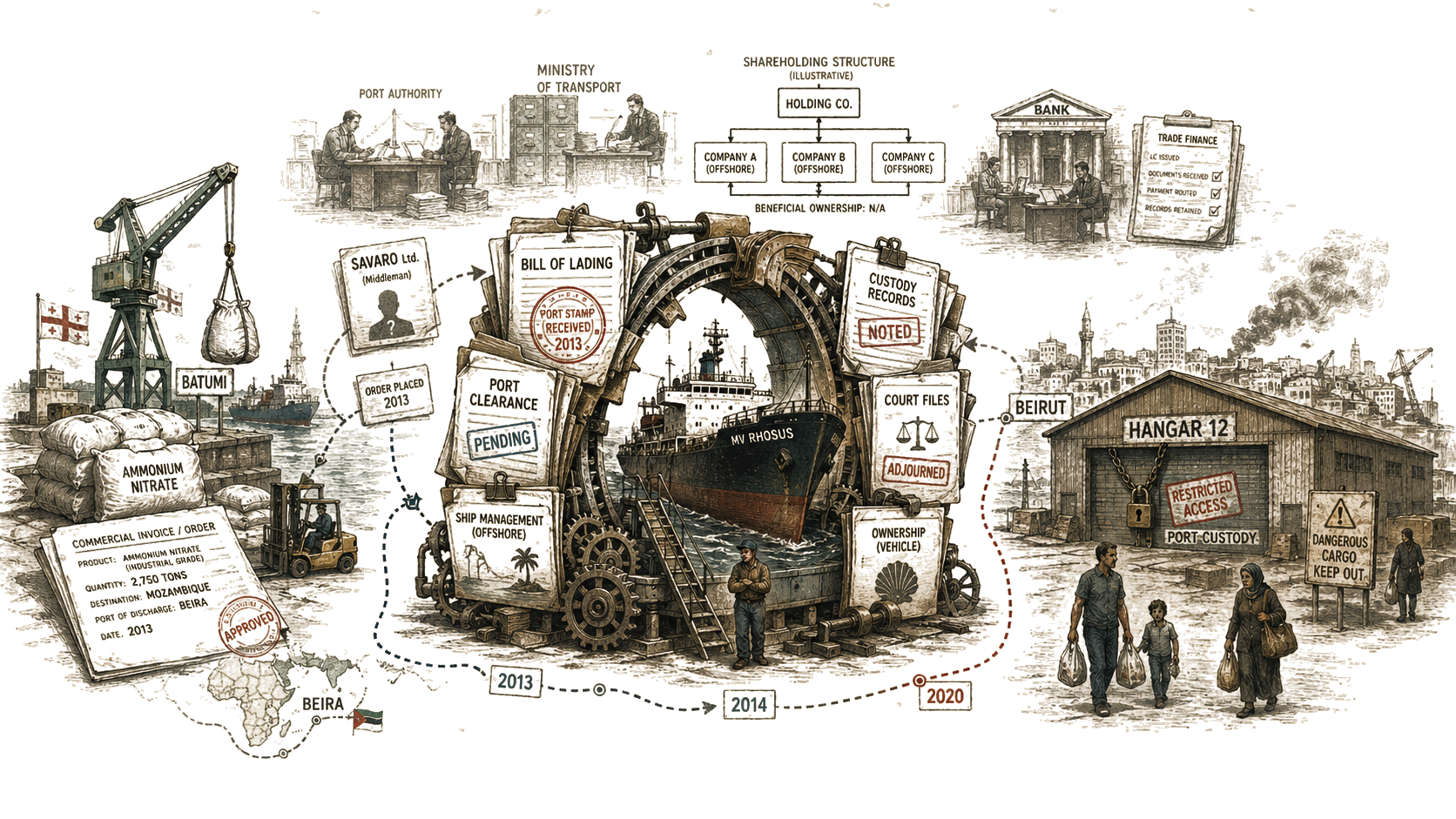
In 2013, as Mozambique's gas future was turning into a security economy, a Ukrainian-linked offshore network moved industrial quantities of ammonium nitrate toward Beira. One shipment broke down in Beirut. Its failure exposed the route.
I. Begin in Beira, not Beirut
The story has usually been told backward.
It begins, in the familiar version, with a mushroom cloud over Beirut on August 4, 2020: a warehouse fire, a flash, a white dome of pressure rolling over the port, windows pulverized miles away, at least 218 dead, 7,000 wounded, hundreds of thousands displaced, and a city left to ask why 2,750 tonnes of ammonium nitrate had been stored in its harbor for years. Source: Human Rights Watch
But the more important beginning is not Beirut. It is Beira, Mozambique.
In 2013, a shipment of high-density ammonium nitrate left Batumi, Georgia, on an old general-cargo ship called the Rhosus. Its papers said the cargo was destined for Fábrica de Explosivos de Moçambique, known as FEM, a Mozambican explosives company. The cargo was brokered through Savaro Ltd., a British-registered company whose real ownership would later become one of the central mysteries of the Beirut blast. The seller was Georgia's Rustavi Azot. The bank named in the cargo-control documents was Banco Internacional de Moçambique, or Millennium BIM. The ship never reached Mozambique. It stopped in Beirut, was detained, abandoned, and eventually sank. The cargo went ashore into Hangar 12. Seven years later, it detonated.
That much is known. It is also incomplete.
Because the Rhosus was not the only nitrate shipment moving toward Beira that year. OCCRP later reported that Savaro-linked channels sent more than 17,000 metric tonnes of ammonium nitrate to Beira in three separate 2013 shipments. FEM told reporters it bought two other Savaro shipments that year totaling nearly 11,000 tonnes of technical-grade ammonium nitrate. A sister company, Agroblend, sent another 6,500 tonnes from Ukraine and Croatia to Beira in August 2013; FEM said it was not that shipment's buyer. Source: OCCRP
That changes everything.
The Rhosus was not simply "the ship that carried the Beirut bomb." It may have been the one shipment in a larger corridor that failed. Most shipments, if the public record is correct, reached Mozambique or at least reached the port of Beira. One did not. One got stuck. One left behind documents, court files, lawyers, crew testimony, ship records, unpaid debts, corporate ghosts, and eventually a crater.
When an interdicted cocaine load appears in a port, investigators do not ask only why that one container existed. They ask how many containers passed before it.
The Rhosus was the container that broke open.
II. A Contract With a Bank in the Middle
The July 2013 sale contract between Rustavi Azot LLC and Savaro Limited is not a confession. It is better than that. It is a map.
On the first page, the seller is named as Rustavi Azot in Georgia; the buyer is Savaro Ltd. in London. The product is listed as 2,750 metric tonnes of high-density ammonium nitrate in one-tonne bags. The final destination is Mozambique. The packaging note says the bags are to be suitable for sea transportation. The marking box says NITROPRILL HD, HIGH DENSITY AMMONIUM NITRATE, and, at the bottom, "PRODUCED FOR FEM." Source: Rustavi-Savaro contract
The second page is where the bank enters. The contract required 100% advance payment from the buyer to the seller, and among the shipping documents it required a clean set of bills of lading "issued or endorsed to order of Banco Internacional de Moçambique," notifying FEM in Maputo. The visible list of documents includes invoices, packing lists, bills of lading, certificates of origin, quantity and quality. It does not visibly list an insurance certificate. Source: Rustavi-Savaro contract
A bank named "to order" on a bill of lading is not decorative. In trade finance, that is control language. It can mean the bank is holding title documents or security over the cargo until payment conditions are met. It does not prove the bank was the commercial end-user. It does prove that BIM's name sat inside the cargo-control chain.
That matters because BIM was not a marginal bank. It was and remains one of Mozambique's central financial institutions, born from a strategic partnership between Banco Comercial Português and the Mozambican state. By the end of 2024, BIM's share capital was majority held by BCP África, part of Millennium BCP, with 66.69%; the Mozambican state held 17.12%, and other public or quasi-public Mozambican entities held additional stakes. Source: 360 Mozambique
The clean explanation is trade finance: FEM ordered a legal industrial explosive precursor; Savaro arranged supply; BIM controlled documents; the ship failed. The dirtier question is why a major bank's document trail touched a high-risk dual-use chemical shipment carried by a vessel that respectable insurers, registries, banks or cargo owners should have examined with alarm.
The public file does not show the cargo insurance. It does not show the hull insurance. It does not show a P&I club in the free vessel database record. VesselFinder lists the Rhosus, IMO 8630344, as a Moldovan-flagged general cargo ship built in 1986, 86.6 meters long, not in service since 2018 — and leaves the P&I Club and classification-society fields blank. Source: VesselFinder
Blank fields are not proof of no insurance. But after a cargo of this nature is abandoned, deteriorates, is inspected, sits for years, and explodes, the absence of a visible insurance trail becomes part of the story.
A serious bank file would contain the answer: the letter of credit or documentary collection, the vessel due diligence, insurance requirements, compliance review, sanctions screening, KYC on Savaro and FEM, and communications with BCP headquarters. If those papers are clean, they would clarify the transaction. If they are thin, missing, or narrowly drafted, they would explain how the cargo became orphaned.
III. The Ship With the Split Identity
The Rhosus itself was almost too bad to be accidental.
The official Beirut story used IMO 8630344. Vessel databases identify that Rhosus as an 86.6-meter Moldovan-flagged cargo ship built in 1986. But a second public VesselTracker record exists under the name M V RHOSUS, IMO 8630339, marked invalid, with call sign EBV9, Panama flag, 87 meters in length, last seen in the Aegean Sea on July 8, 2009. Source: VesselTracker
This is not proof of a conspiracy. Maritime databases contain errors, stale AIS records, rounded measurements, transponder mistakes and historical fragments. But ship identity is supposed to be precisely the part of maritime life that does not drift. The IMO number exists as a vessel's permanent identity: it remains with the ship for life, regardless of changes in name, ownership, activity or flag. Source: International Maritime Organization
The split record is therefore not a smoking gun. It is a scar.
And the rest of the ship's paper life is full of scars. OCCRP found that the man often described as the owner, Igor Grechushkin, did not own the Rhosus on paper. Through a Marshall Islands company, Teto Shipping, he chartered the vessel from Panama-registered Briarwood Corporation. Cypriot court records tied Briarwood to Charalambos Manoli, a Cypriot shipping businessman. Manoli denied responsibility for the ship at the relevant time, but the corporate chain around the vessel kept circling back toward his companies. Source: OCCRP
Manoli-linked companies helped register the Rhosus under the Moldovan flag, provided intermediary services, and certified it. A Georgian company then owned by Manoli, Maritime Lloyd, issued a certificate in late July 2013 saying the vessel had been safely constructed. Days later, port inspectors in Seville detained the ship, citing 14 defects, including auxiliary-power problems. Source: OCCRP
Then, just before the final voyage, another Manoli company helped arrange a generator rental from Aggreko. The unpaid bill for that generator later became one of the debts that helped trap the Rhosus in Beirut. Source: OCCRP
This is how maritime opacity works. It rarely announces itself as fraud. It appears as layers: a Panama owner, a Marshall Islands charterer, a Moldovan flag, a Georgian class certificate, a Cypriot businessman, a Russian-Cypriot operator, a Bulgarian mailbox, a ship too poor to sail and too useful to scrap.
Then someone loaded it with 2,750 tonnes of explosive precursor.
IV. Dnipro Enters the File
For years, Savaro looked like one more British shell company: a London address, nominee services, dormant filings, no obvious operational life. Then the file moved east.
OCCRP and partners reported in 2021 that Savaro's ownership and operating network traced back to Volodymyr Verbonol, a Ukrainian businessman from Dnipro, and to a broader network involving Verbonol, his father-in-law Mykola Aliseyenko, offshore structures, and companies trading in fertilizers and chemicals. The network used entities in England, Scotland, the British Virgin Islands, Ukraine, the Marshall Islands, the United States and elsewhere. Source: OCCRP
On paper, Savaro and Agroblend were not tied to Ukraine. In practice, reporters found shared infrastructure. Emails sent after the Rhosus was detained came from an Agroblend representative using the name Curtis Igleheart, who later sent messages from a savaro.com account. OCCRP found savaro.com shared an email server and IP infrastructure with Savaro's Ukrainian branch and other network sites advertising fertilizers and chemicals. Savaro also paid Lebanese lawyer Joseph Kareh from an account in its name at the Cyprus branch of Ukrainian-owned PrivatBank to inspect the Beirut ammonium nitrate in 2015. Source: OCCRP
The social map is more valuable than any single signature. Verbonol was not a random clerk. OCCRP described him as a figure who came through Dnipro's business and political circles, worked for a prominent trade-union leader, later worked for former MP Denys Dzenzersky, partnered in business, and founded Atlantis Corporation in 2001, marketing fertilizers and other products. One of the companies in that orbit was the Ukrainian branch of Savaro, created in 2009. Source: OCCRP
Then comes the name FEM remembered.
FEM's spokesman told OCCRP that, as far as he knew, Savaro was a Ukrainian company whose boss was known simply as "Mr. Volodymir." Source: OCCRP
This is not courtroom proof that Verbonol was the man behind every instruction. It is better used as a social clue: the Mozambican buyer's side did not know Savaro as a faceless British paper company. It knew a Ukrainian "Mr. Volodymir." That is a relationship, not just an invoice.
Later, after legal action loomed in London, Savaro's ownership was transferred in August 2021 to another Volodymyr: Ukrainian lawyer Volodymyr Hliadchenko. Ukrainian records, OCCRP reported, showed him as an apparent nominee owner of at least a dozen local companies, including one at the same address as Savaro's Ukraine branch. Hliadchenko said he had been looking to buy a London company and selected Savaro at the suggestion of other Ukrainian lawyers. Source: OCCRP
That explanation may be true. It is also almost absurdly convenient. A company connected to the Beirut blast is transferred, as litigation approaches, to a lawyer who says he happened to want a London company. If Verbonol is the operational trail, Hliadchenko is the late-stage corpse-holder: the man who appears when the paper body needs a new pair of hands.
V. FEM Was Never Just a Factory
The nitrate was supposedly going to a commercial explosives company. That phrase can lull the reader. It should not.
FEM is not just a factory in the abstract. OCCRP reported that FEM was 95% owned by the family of the late Portuguese businessman António Moura Vieira through Moura Silva & Filhos, a Portuguese explosives group. It also reported that FEM was part of a network of companies connected to Mozambique's ruling elite, and that related companies had been investigated over illicit arms trafficking and explosives. Source: OCCRP
The connections thicken around Nuno Vieira, FEM's head. OCCRP reported that Vieira had been, since 2012, a business partner of Jacinto Nyusi, son of Filipe Nyusi, who was Mozambique's defense minister at the time and later became president. The same year, Vieira, Mozambique's state investment company Monte Binga, and the state intelligence service founded Mudemol, a munitions and explosives manufacturer that supplied the military. Monte Binga was later flagged by the United Nations for alleged North Korea sanctions violations. Source: OCCRP
This does not prove the Rhosus nitrate was meant for war. It proves the buyer ecosystem stood at the seam where commercial explosives, state security, ruling-party families, military supply and intelligence-adjacent companies meet.
That seam matters in Mozambique in 2013.
By then, the country's offshore gas discoveries had transformed its political horizon. Analysts would later describe the renewed RENAMO conflict not merely as a replay of old grievances but as a struggle in which future gas revenues had become central to political bargaining. Columbia's Journal of International Affairs argued that by the time RENAMO returned to violence in 2013, potential gas revenues had become a key issue in Mozambican politics, and violence gave RENAMO leverage to demand a reorganization of the state and access to future gas exploitation. Source: Columbia Journal of International Affairs
Chatham House later described RENAMO leader Afonso Dhlakama's provincial-autonomy proposal as an attempt to gain control over patronage positions and draw rents from resource-rich provinces, including areas connected to minerals, gas and oil taxation. Source: Chatham House
In other words, the renewed conflict was not just an "incident." It was a rent struggle, a state-structure struggle, a future-resource struggle. Whether or not outside actors nudged it, the violence was useful to anyone who benefited from a securitized Mozambique: security contractors, political brokers, banks, military suppliers, surveillance firms, and those who could monetize the expectation of gas before the gas had paid a cent to the public.
In that world, thousands of tonnes of technical-grade ammonium nitrate moving through a politically connected explosives company is not ordinary background. It is the material vocabulary of a state preparing, bargaining, building, mining, blasting, guarding and perhaps fighting.
VI. The Security Economy Was Already Borrowing in Secret
The nitrate corridor did not run through an innocent financial landscape.
Between 2013 and 2015, Mozambique entered what became known as the hidden-debt scandal. State-controlled companies — ProIndicus, EMATUM and Mozambique Asset Management — borrowed more than $2 billion through Credit Suisse and VTB-linked financing for maritime projects involving tuna fishing, shipyards and coastal surveillance. The loans were hidden from parliament and the public; hundreds of millions went missing; the scandal triggered a currency collapse and sovereign-debt crisis. Reuters reported that Mozambique's constitutional court later declared two loans and their state guarantees void. Source: Reuters
The U.S. Justice Department later described the scheme more bluntly. In 2024, former Mozambican finance minister Manuel Chang was convicted in Brooklyn for his role in a $2 billion fraud, bribery and money-laundering scheme. DOJ said more than $200 million of loan proceeds were diverted to bribes and kickbacks, including more than $150 million to Mozambican officials and about $50 million to bankers. The projects were maritime projects, supplied by Privinvest, a United Arab Emirates-based shipbuilding group. Source: U.S. Department of Justice
This is not the Rhosus shipment. But it is the same room.
The hidden-debt companies were not marginal to Mozambique's gas future. A parliamentary-report summary published by Joseph Hanlon's Mozambique Political Process Bulletin noted that a major source of projected income for ProIndicus was the protection of offshore gas installations and related shipping. Source: Mozambique Political Process Bulletin
So place the pieces in time.
In 2013, RENAMO's conflict returns. Mozambique's gas future becomes a political prize. Secret maritime-security debts are being assembled. A politically connected explosives company buys large quantities of technical-grade ammonium nitrate through a Ukrainian/offshore network. A major Mozambican bank's name appears on the bill-of-lading control chain. A broken ship carries one load and fails.
No single document says these are one plot.
But history rarely presents itself as one document.
What appears instead is a procurement atmosphere: future gas wealth, present security panic, offshore intermediaries, banks, explosives, maritime security, foreign contractors, and political families. The Rhosus did not sail beside that world. It sailed through it.
VII. Angola: Not the Invoice, the Method
The Angola lead is easy to overstate and impossible to ignore.
In December 2011, the IMF identified an unexplained $32 billion discrepancy in Angolan government accounts from 2007 through 2010. Human Rights Watch pressed Angola to explain public funds apparently connected to the state oil company Sonangol. Angola denied that money was "missing," saying the discrepancy resulted mainly from insufficient records of the use of oil revenues. Source: Human Rights Watch
The public record does not show that Angola's missing billions bought the Rhosus cargo. The Rhosus cargo was worth hundreds of thousands of dollars, not billions. But Angola gives the method: state resource wealth, oil-company opacity, politically exposed finance, Portuguese banking channels, offshore structures and elite deniability.
That method crosses into the same banking geography as Mozambique.
Millennium BIM, the bank in the Rhosus bill-of-lading chain, sits below Portugal's Millennium BCP. Sonangol has been a major shareholder in Millennium BCP; BCP's shareholder structure has repeatedly listed Sonangol with nearly 19.5% in recent years, alongside Fosun as another major shareholder. Source: Millennium BCP
Then there is Isabel dos Santos, daughter of Angola's long-ruling president José Eduardo dos Santos. In 2015, Reuters reported that she proposed a merger between Millennium BCP and Banco BPI, two of Portugal's largest listed banks. She was BPI's second-largest shareholder with 18.6%, and a source described her stake as strategic rather than merely financial. Source: Reuters
That proposal did not make her part of the Rhosus transaction. But it places her exactly where serious investigators should look: the Lusophone banking corridor linking Angola, Portugal and Mozambique. Other journalists might treat the BCP/BPI merger push as corporate finance trivia. It is not trivia. It is a politically exposed Angolan fortune attempting to shape the banking architecture above the same Portuguese-Mozambican bank group whose Mozambican subsidiary appears in the nitrate documents.
The dos Santos file also shows how money moved when Angola's resource elite needed friendly jurisdictions. ICIJ's Luanda Leaks investigation reported that, after Isabel dos Santos was dismissed from Sonangol, Sonangol requested a $38 million payment to Matter Business Solutions, a Dubai company controlled by a dos Santos business partner. Confidential Sonangol records reviewed by ICIJ showed three payments worth about $58 million to Matter the day after her dismissal was announced. Dos Santos and Matter's representatives denied wrongdoing, saying the payments were legitimate services. Source: ICIJ
Later reporting showed Matter forwarding tens of millions to major consulting firms — $31.2 million to Boston Consulting Group, $21.4 million to PwC and $15.4 million to McKinsey — as part of a Sonangol modernization project. Source: ICIJ
Again, no public document connects Matter to Savaro, FEM or the Rhosus. But Matter proves the style: state oil company, politically connected management, Dubai company, professional-services paperwork, banks, consultants, deniability.
In 2024, Britain sanctioned Isabel dos Santos under its anti-corruption regime, saying she abused positions at Sonangol and Unitel to embezzle at least £350 million. She denied the allegations and called the sanctions incorrect and unjustified. Source: Reuters
The Angola chapter is therefore not "Angola paid for the bomb." It is darker and more durable: Angola shows how resource states can make money disappear into accounting fog, banking structures and friendly intermediaries. Mozambique, in 2013, was becoming the next resource-security state. The machinery was familiar.
VIII. Beirut Was Not Blind
A common explanation of the Beirut blast is negligence. It is true as far as it goes. It does not go far enough.
In 2026, OCCRP reported that UNIFIL's Maritime Task Force flagged the Rhosus as a "vessel of interest" when it arrived at Beirut in November 2013. Lebanese naval forces boarded and inspected the ship. The navy's note said the vessel was clear and nothing illegal was reported. The inspection was later omitted from a Lebanese Armed Forces report submitted after the blast. Source: OCCRP
The ship's documents showed the cargo. OCCRP reported that the bill of lading stated 2,750 tonnes of high-density ammonium nitrate and that the cargo manifest named an explosives company in Mozambique. Photographs showed bags labeled Nitroprill HD with hazardous-material markings. Source: OCCRP
So the Rhosus was not invisible at arrival. It was seen. It was flagged. It was boarded. It was cleared. Then it was detained, abandoned and folded into Lebanon's port bureaucracy.
Savaro did not simply forget the cargo. In 2015, it hired Lebanese lawyer Joseph Kareh to petition a court to inspect the quantity and quality of the ammonium nitrate in the warehouse. The expert report found that approximately 1,900 one-tonne bags were ripped and spilling. Savaro declined chemical testing and, according to OCCRP, there is no record that it tried to recover the material afterward. Source: OCCRP
That is one of the dirtiest moments in the file.
A company with no interest in the cargo does not pay a lawyer to inspect it. A company determined to recover its cargo does not stop after learning most bags are torn. The inspection reads like reconnaissance: what remains, what condition is it in, is it usable, is it worth recovering, is it better abandoned?
By July 2020, the warehouse itself had become a theft scene waiting to happen. Lebanese security services warned that one door was missing and there was a hole in the southern wall. Their report warned that, in case of theft, a thief could turn the goods into explosives. Source: OCCRP
The disputed blast-yield question belongs here. OCCRP reported that the FBI had reportedly concluded only 20% of the Rhosus cargo exploded, raising questions about what happened to the rest. Other experts have argued that most or all of the ammonium nitrate may have detonated. The public evidence does not settle it. But once officials themselves recorded missing doors, wall breaches and theft risk, the theft hypothesis becomes a legitimate investigative line, not internet fantasy. Source: OCCRP
If the cargo was intact, the scandal is state failure. If part of it vanished, the scandal is also a smuggling file.
Either way, the cargo had become an orphan: legally present, physically dangerous, economically toxic, and claimed only when someone wanted information from it.
IX. The Syrian Shadow Is Stronger Than the Israeli One
There is always a temptation to look for the most spectacular hidden beneficiary. The better discipline is to follow the documents.
The public record does not show an Israeli-linked broker, bank, end-user certificate, officer, shipping route or procurement document connected to the Rhosus cargo. Israel appears in wider Middle Eastern and historical resource-security contexts, but not in the visible nitrate chain.
The stronger Middle East alternative is Syria-adjacent.
OCCRP reported that the same offshore service providers that helped obscure Savaro-related structures — Cyprus-based Interstatus and the U.K.-based Alpha and Omega group — also acted as nominees for firms belonging to Syrian regime-aligned businessman George Haswani and Syrian-Russian businessman Imad Khouri. A Haswani company, Hesco Engineering and Construction, shared U.K. addresses with Savaro, and the companies moved between addresses on the same dates in 2008 and 2011. Source: OCCRP
The timing is the hot point. OCCRP reported that Mudalal Khuri was sanctioned for helping in an attempt to procure ammonium nitrate for Assad's government in 2013 — the same year the Rhosus reached Beirut. It also reported that Khouri brothers often referred clients to FBME, the Lebanese-owned bank in Cyprus and Tanzania that U.S. authorities declared a primary money-laundering concern. Hesco was also an FBME customer. Haswani denied any connection to the Rhosus shipment. Source: OCCRP
The Guardian, citing a Lebanese investigation aired by Al-Jadeed, also reported that Savaro had been linked through addresses to figures tied to the Syrian regime, reinforcing suspicions that Beirut, not Mozambique, may have been the intended destination. Source: The Guardian
This does not prove Syria was the hidden end-user. It makes Syria the more document-based hidden-end-user hypothesis.
The Manoli-FBME trail tightens the atmosphere. OCCRP reported that Manoli had debt exposure to FBME, a bank later accused by U.S. authorities of major money-laundering failures; at one stage, the Rhosus was offered as collateral to the bank. Source: OCCRP
So the Beirut branch of the file has two possible forms. In one, the cargo was genuinely Mozambique-bound, then became useful to war-economy actors after it was stranded. In the other, Mozambique was always the cover destination and Beirut was the placement. The documents do not yet choose for us. They do, however, make the old innocent sentence — "a broken ship accidentally left fertilizer in Beirut" — look childish.
X. The Court Found a Company, Not the Owner
After the blast, the world found Savaro. It did not find Savaro's real master.
In 2023, the High Court in London held Savaro Ltd liable for death, personal injury and property damage from the Beirut port explosion. Reuters reported that the court ordered Savaro to pay damages to victims and relatives, a rare legal victory in a case otherwise stalled by Lebanese political obstruction. Source: Reuters
But liability against a shell company is not the same as accountability against the person who controlled it. The central question remains: who was Savaro's beneficial owner or controller in 2013, when the cargo was ordered, and in 2015, when it inspected the warehouse?
Grechushkin, the Rhosus operator, resurfaced years later. In 2025, Bulgarian authorities detained him on an Interpol notice connected to Lebanon's case. In December 2025, a Bulgarian court rejected Lebanon's extradition request, citing insufficient assurances that he would not face the death penalty. Source: Reuters
The pattern repeats: a man appears, the law reaches, procedure intervenes, and the deeper owner remains behind the curtain.
XI. The Gas Did Not Disappear
By 2026, Mozambique's gas prize was no longer only a promise. It had begun arriving, but late, securitized and unevenly offshore.
Eni's Coral South floating LNG project began exports in 2022. In 2025, Eni and partners approved Coral North, a second floating LNG platform scheduled to start operations in 2028 and projected to generate $23 billion in tax revenues. Source: Reuters
The larger onshore project led by TotalEnergies was halted in 2021 after Islamist militant attacks in Cabo Delgado. In January 2026, Reuters reported that Mozambique and TotalEnergies agreed to relaunch construction of the $20 billion LNG project, targeting first LNG by 2029, with security improved by Rwandan troop deployment but the insurgency still simmering. Source: Reuters
So the gas survived the wars, debts and scandals. Whether the public will benefit from it is another matter.
This is the cruel rhythm of resource states. The debt is immediate. The security costs are immediate. The secrecy is immediate. The public revenues are deferred. The people are told to wait for transformation while the procurement machine transforms itself first.
XII. The Theories the Evidence Now Permits
Only after walking the route — Beira, Batumi, Dnipro, Maputo, Lisbon, Luanda, Cyprus, Beirut, Dubai, London — can the theories be stated honestly.
The first and strongest theory is the Beira nitrate corridor. In 2013, a Ukrainian-linked offshore network moved industrial quantities of technical-grade ammonium nitrate toward Mozambique. FEM purchased multiple Savaro shipments. Agroblend sent another large shipment whose buyer remains unclear. The Rhosus shipment was not unique; it was the one that failed and exposed the corridor.
The second theory is the Mozambique security-procurement overlap. The nitrate corridor ran into FEM, a company embedded in a politically connected explosives ecosystem linked by public reporting to the Nyusi family environment, Mudemol, SISE, Monte Binga and military supply. This happened in the same period Mozambique's gas future, RENAMO violence and secret maritime-security borrowing were remaking the state. The ammonium nitrate may have had lawful commercial uses. But the buyer ecosystem was not socially distant from security power.
The third theory is the orphaned-cargo / war-economy opportunity. Once stranded in Beirut, the cargo may have become useful to other actors. Savaro inspected it but did not recover it. The warehouse was insecure. The amount that exploded remains contested. The Syrian-adjacent corporate-service overlaps, FBME connections and 2013 ammonium-nitrate procurement context make this theory live. It does not require the cargo to have been Syria-bound from the beginning; it requires only that abandoned explosive precursor in Beirut became an opportunity.
The fourth theory is Angola as method, not invoice. No public document shows Angola's $32 billion accounting fog bought the Rhosus cargo. But Angola's Sonangol opacity, Isabel dos Santos's Portuguese-banking ambitions, Matter Business Solutions in Dubai, and BCP/Sonangol/BIM geometry show a Lusophone resource-finance architecture in which state oil and gas expectations, banks, politically exposed persons, offshore companies and professional intermediaries could move value through fog.
These theories do not cancel one another. They layer.
A shipment can be commercially ordered and politically useful. A bank can be doing trade finance and still be a control point. A buyer can be legitimate and still sit inside a military-adjacent network. A cargo can be Mozambique-bound and later become a Syrian-war opportunity. Angola can be unrelated to the invoice and still reveal the operating method. The Rhosus can be a failed shipment and also a window into the successful ones.
XIII. The Missing Subpoenas
The public record cannot yet write the final sentence. It can name the documents that would.
The Beira port records would show every 2013 ammonium nitrate shipment linked to Savaro, Agroblend, FEM, Rustavi Azot, MUR Shipping, BIM or Moura entities: vessel names, flags, owners, insurers, bills of lading, customs entries and final consignees.
FEM's stockbooks would show how much nitrate entered, how much became explosives, and who bought the finished product — mines, infrastructure firms, gas contractors, state-security entities, Monte Binga, Mudemol, ProIndicus, military channels or private intermediaries.
BIM's trade-finance file would show whether the bank vetted the vessel, required insurance, screened Savaro, reviewed FEM's end use, or treated the transaction as routine paper.
Savaro's bank records would show who funded Rustavi, who paid freight, who paid Joseph Kareh, who controlled the PrivatBank Cyprus account, and who instructed the 2015 inspection.
Interstatus and Alpha and Omega's KYC files would show the real beneficial owner behind Savaro in 2013.
Lebanese port access logs, warehouse photographs, customs inventories, army correspondence and CCTV would show whether Hangar 12 was merely neglected or accessed.
Moura Silva's Angola and Mozambique files would show whether the explosives network had common contracts, directors, banks or customers across Angola, Mozambique and Portugal.
BCP/BIM board and compliance records would show whether anyone above Mozambique saw the nitrate transaction, and whether Sonangol-linked influence at the BCP level was merely shareholder background or part of the governance atmosphere.
The records may prove the innocent version. They may prove the darker version. More likely, they will prove what this file already suggests: not one clean conspiracy, but a system of plausible deniability built to survive contact with disaster.
XIV. The Machine
There is a sentence that cannot be written from the public record: "Angola's missing billions bought the Beirut bomb."
There is another sentence that can be written.
In 2013, while Mozambique's peace was cracking and its future gas wealth was becoming a political weapon, a Ukrainian/offshore chemical-trading network moved large quantities of technical-grade ammonium nitrate toward Beira. The intended recipient of one failed shipment was a politically connected explosives company with military-adjacent ties. The cargo documents placed Mozambique's largest bank in the title-control chain. The country was simultaneously building secret maritime-security debts around the same gas future. Upstream of the bank sat a Portuguese banking group in which Sonangol was a major shareholder, while Angola's oil elite showed, through other files, how resource money could move through banks, shells, consultants and Dubai companies. The ship carrying the failed shipment was old, opaque, badly certified, debt-ridden and surrounded by offshore ownership. When it stopped in Beirut, Lebanese forces inspected it and did not flag the danger. The middleman later inspected the cargo but did not retrieve it. The warehouse was insecure. The blast came years later. The owner of the cargo remains, in the deepest sense, unnamed.
That is not fog. That is a machine seen through smoke.
The machine's genius is that every participant can deny owning the whole. The bank can say it was not the buyer. The buyer can say it never paid because the cargo never arrived. The trader can say it was an intermediary. The shell can say it was dormant. The ship operator can say he was not the owner. The owner can say he transferred the shares. The port can say it waited for the court. The army can say it was not its warehouse. The court can say no one petitioned correctly. The state can say it was negligence.
By the end, a million-dollar cargo had become nobody's property.
That is how the bomb survived. Not because no one saw it. Because everyone saw only the part they could later disown.



 We respect your privacy.